Ray Dalio: Bridgewater, Radical Transparency, and the All Weather Portfolio
Dalio built the world's largest hedge fund on a culture of brutal honesty and a portfolio designed to survive economic conditions nobody can predict in advance.
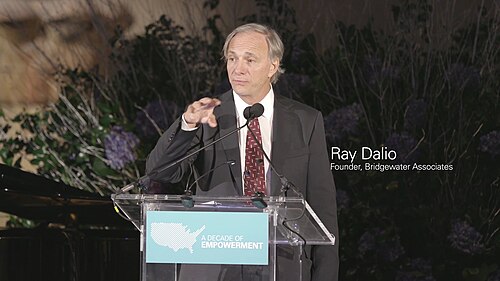
Photo: Grameen America · CC BY 3.0, via Wikimedia Commons
From a spare bedroom to the world's largest hedge fund
Ray Dalio founded Bridgewater Associates in 1975, reportedly out of his New York City apartment, and built it over the following decades into one of the largest hedge funds in the world by assets under management, serving pension funds, central banks, and sovereign wealth funds rather than primarily individual investors. Bridgewater's institutional client base and macroeconomic focus — betting on the direction of interest rates, currencies, and economic growth across entire countries — set it apart from stock-picking-focused investors like Buffett or Lynch.
The "All Weather" idea: stop trying to predict the season
Dalio's best-known contribution to portfolio construction is the All Weather concept, built on a simple observation: different asset classes tend to perform well in different economic environments — stocks in growth periods, certain bonds in deflationary slowdowns, commodities and inflation-linked assets when inflation runs hot — and nobody can reliably predict in advance which environment is coming next. Rather than trying to forecast the economy and rotate accordingly, All Weather aims to hold a mix of assets balanced so that some portion of the portfolio should perform reasonably well no matter which economic environment actually shows up.
- The approach is often associated with "risk parity" investing, which balances a portfolio by each asset's risk contribution rather than simply its dollar allocation.
- It generally holds a mix of stocks, long- and intermediate-term bonds, and inflation-hedging assets like commodities or inflation-linked bonds.
- The goal isn't to maximize returns in any single environment — it's to avoid being badly hurt by whichever environment arrives, at the cost of sometimes lagging in the best years for stocks specifically.
Radical transparency: an unusual way to run a company
Beyond his investment approach, Dalio became almost equally well known for Bridgewater's internal culture, which he described in his book "Principles." Employees were encouraged, and in some cases required, to openly challenge each other's reasoning in meetings — including challenging Dalio's own decisions — on the theory that suppressing honest disagreement, out of politeness or hierarchy, leads to worse decisions over time. Meetings were often recorded, and employees rated each other's contributions using internal tools, an unusually blunt approach to workplace feedback that drew both admiration and significant criticism over the years, including reporting on its effect on workplace culture and turnover.
Dalio's pitch for radical transparency was that most organizations lose good decisions not to a lack of smart people, but to smart people quietly disagreeing and staying silent about it.
Stepping back from day-to-day management
Dalio gradually transitioned away from Bridgewater's daily operations in the years leading up to and following 2022, moving into a mentor and board role as a younger generation of leadership took over active management of the firm. His writing, particularly "Principles" and his economic commentary on debt cycles, remains the more widely read part of his public legacy for readers outside of Bridgewater's institutional client base.
This article is educational and general in nature. It isn’t personalized investment, tax, or legal advice — always weigh your own circumstances, or talk to a licensed professional, before making financial decisions.
Keep reading
Related guides on this topic.
Neil Woodford: The Star Fund Manager Whose Fund Froze, and the Lessons for Investors
Neil Woodford was Britain’s most famous fund manager until his £10 billion fund froze in June 2019, trapping hundreds of thousands of savers. What happened, what the FCA decided in 2025, and the lessons for anyone who buys a fund because of the name behind it.
Legendary InvestorsLuiz Barsi Filho: Brazil’s “King of Dividends” and His Retirement Portfolio
From shoeshine boy in São Paulo to the largest individual investor on Brazil’s stock exchange, Luiz Barsi built his fortune by buying dividend-paying shares every month for decades and almost never selling.
 Personal Finance & Retirement
Asset Allocation Explained: How to Split Your Money Between Shares, Bonds and Cash
How you divide your money between shares, bonds and cash shapes your results more than which funds you pick. What asset allocation is, how to choose a mix that fits your goals and nerves, and how to keep it on track.
 Cryptocurrency
How Much Crypto Belongs in a Portfolio?
There is no correct percentage. There is only a loss you could absorb without changing your plans — and that is a different question, with a personal answer.
Legendary InvestorsRaamdeo Agrawal: The Co-Founder of Motilal Oswal and His QGLP Approach to Investing
Raamdeo Agrawal arrived in Mumbai to study accountancy, co-founded Motilal Oswal and became one of India’s best-known long-term investors. His QGLP framework, the Hero Honda and Eicher stories, and the lessons for ordinary investors.
Legendary InvestorsAshish Kacholia: India’s “Big Whale” of Small-Cap Investing
Ashish Kacholia started as a broker and analyst, co-founded Hungama with Rakesh Jhunjhunwala and became one of India’s most-watched small-cap investors. His story, his approach, what his portfolio looks like, and why copying it is harder than it seems.